PIT Audit Registry
Is as-filed SEC EDGAR data safe for cross-sectional signals?
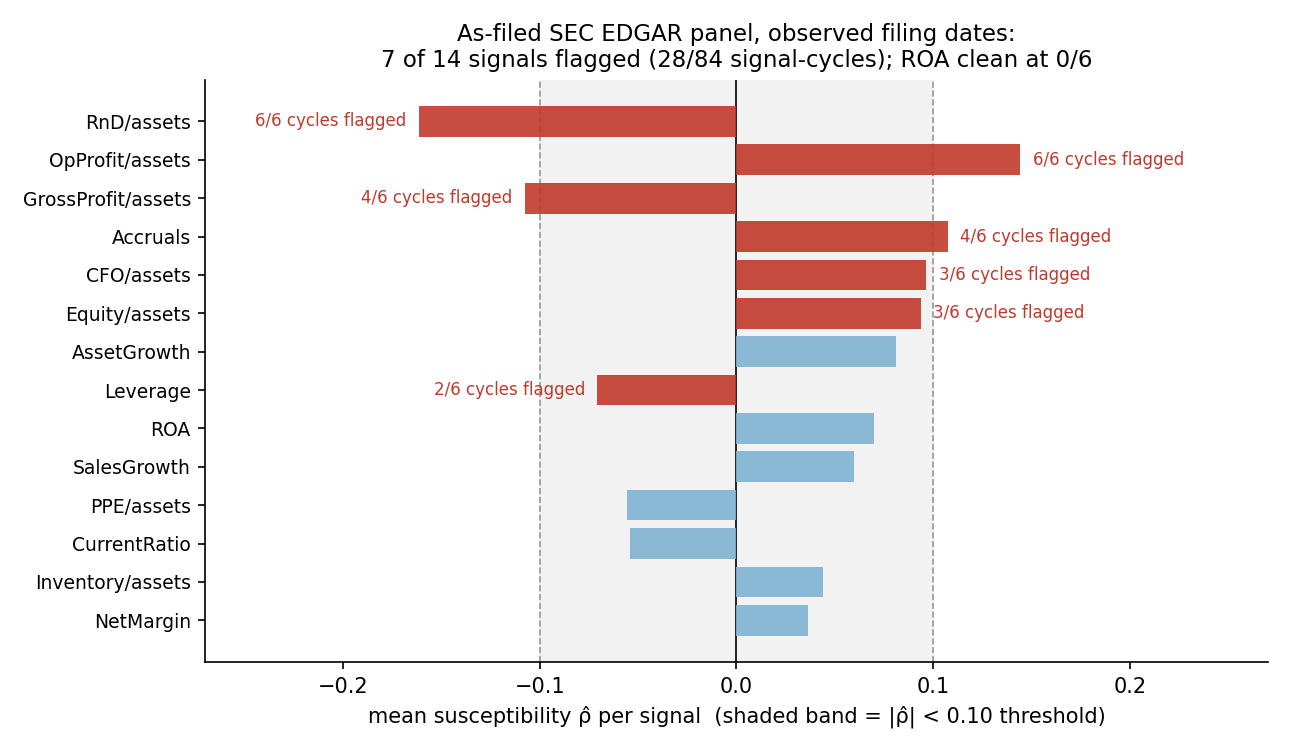
Not uniformly. On a US panel rebuilt from as-filed EDGAR filings, on observed filing dates (856 firms, 8,118 firm-years, coverage 2011–2025), the screen flags 7 of 14 standard fundamental signals — 28 of 84 signal-cycles (frozen protocol, threshold 0.10):
| flagged | clean |
|---|---|
RnD/assets (6/6), OpProfit/assets (6/6), GrossProfit/assets (4/6), Accruals (4/6), CFO/assets (3/6), Equity/assets (3/6), Leverage (2/6) |
ROA (0/6), NetMargin, AssetGrowth, SalesGrowth, Inventory/assets, PPE/assets, CurrentRatio |
ROA — the headline signal in the underlying method paper — is clean: its raw
latency correlation of −0.296 conditions down to +0.097 once size is
controlled, and it is flagged in 0 of 6 graded cycles. That result does not
generalise across the panel, which is the point: susceptibility is
signal-specific, and a per-signal screen is the instrument that tells them
apart.
Why this page exists
Curated datasets pass this screen — OSAP because of its uniform annual update calendar, JKP Global Factor Data because of its documented four-month availability convention. Both protections live in the publication calendar, not in the signal definitions. This page is the measured baseline of what happens without one: rebuild the same kinds of signals from raw filings at the dates they actually arrived, and half of them carry the leakage channel.
Reproduce it
The full panel (edgar_panel.parquet, 914 KB, built from free SEC
companyfacts and submissions endpoints) and every script are published with
the report; each number regenerates from the publication directory.
Full report, panel and scripts · Registry · Method paper · Screen implementation